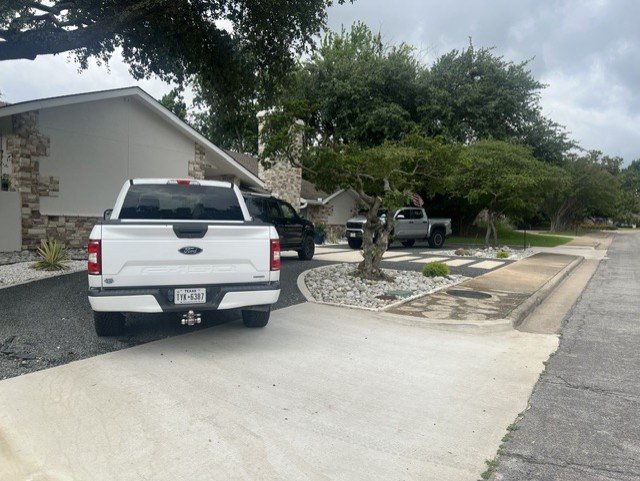
While walking my dog this morning, we passed seven one-and-one-half ton American pickup trucks before we finished the first block in our residential area of Dallas, including those two in the attached picture. Uniquely American, pickup trucks form the transportation backbone of the entrepreneurial class of American workers. These trucks peppering my neighborhood today, and most workdays, are used by plumbers, carpenters, painters, electricians, landscapers, and other workers maintaining the fruits of modern American living. Without these relatively low-cost vehicles, tens of millions of Americans, including these workers, would not be enjoying the proverbial ‘American Dream’.
Ford introduced the first pickup truck a century ago, 1925, by pairing a Model T frame and engine with a new pickup-style body. Today, the Ford F-Series is America’s best-selling line of light trucks, ahead of the Chevrolet Silverado and Dodge Ram. Each U.S. manufacturer relies on a nationwide dealership network to sell vehicles, make repairs, provide parts, and support factory warranties and recalls—helping keep these truck fleets on the road and available for frequent use.
The June 20-21 issue of the Wall Streel Journal featured an article ‘The EV Pickup Strikes Back’ in which the reporter advocates an EV redo of the first generation of mass-market electrical pickups that ended in financial disaster. He said automakers will try again with smaller designs. The WSJ writer describes himself as a city-dweller and homeowner who needs a pickup truck for innumerable small jobs throughout the year, and who is ‘among those that aspire to buy a swell little electric pickup’.
This is an entirely different vehicle market than those which must support the owner’s economic wellbeing that must operate in a range of constant heavy duty use areas. The distances required are far beyond those required for traveling around the local area to pick up plants and fertilizer. Maybe the writer just needs a golf-cart with the back seats replaced with an attached cargo bed.
The article concludes with a summary of options being considered by various new and old vehicle manufacturers to overcome the current deficiencies which doomed Ford’s EV Lightning as an alternative to conventional internal combustion engine power. One EV Lightning problem was that adding loads to the vehicle significantly shortened the vehicle’s range. Adding more battery arrays to obtain greater range were expensive, and the extra battery weight mitigated the range extensions being sought. The working downtime while charging an EV may not be an issue for the WSJ writer, but time is money for the working pickup truck owner who has no societal need to virtue-signal his EV usage to Save the Planet.
WSJ reported in an article on June 24 that ‘This Car Startup Backed by Bezos Is Developing a $25,000 EV Truck’. Entry-level Ford F-150’s are available today for less than $37,000. The Ford Maverick with hybrid engine power is already being offered for $28,352. Ford is planning a new EV model selling for $30,000. Whether Bezos’s investment in Slade Auto’s new starter pickup truck will find a successful $25,000 market segment against Ford’s strong position in the pickup truck sweepstakes seems very problematical.
EV vehicles will find their place in the marketplace as the technology and supporting services around them are developed, however, trying to force them into markets unsuitable for their use will only cause more financial losses for those who do not fully understand and address the different environments in which they will be used. Likewise, unproven scientific or emotional arguments should not overcome practical considerations when attempting to change the world.
The pickup truck has been one of the most successful American productivity inventions of the past century. If it ain’t broke, don’t try to fix it!
TW3
June 25, 2026
John Whitmore Jenkins
www.jenkins-speaks.com
john@jenkins-speaks.com