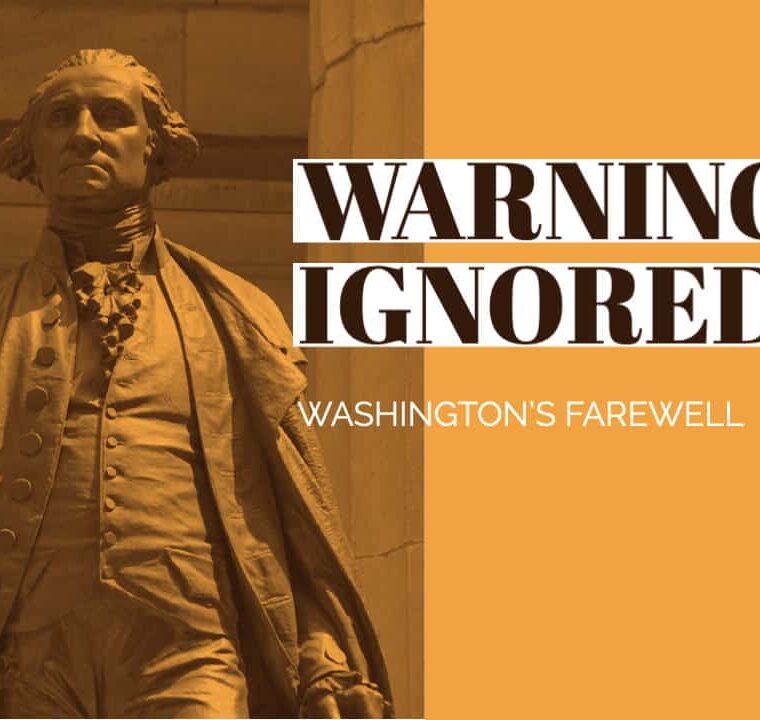
George Washington would not have written his Farewell Address if he did not have a low opinion of politicians. After twenty years of experience in public service, he addressed this document to “Friends and Fellow-Citizens” outlining for them his concern of the past, present, and future mischiefs of our politicians. Washington was prescient in that every area of concern he mentioned has become a mischief, or worse, in modern American politics. The major areas from his address that will be covered here are: divisive party politics, loss of religion and morality, public debt, usurpation of Constitutional power, and avoiding foreign alliances.
Party politics immediately developed when newly elected President Washington took office. He described his concerns as: “associations may now and then answer popular ends, they are likely, in the course of time and things, to become potent engines by which cunning, ambitious, and unprincipled men will be enabled to subvert the power of the people and to usurp for themselves the reins of government, destroying afterwards the very engines which have lifted them to unjust dominion”.
Within the last twenty years, our dominant two parties have lost popular support to where as much as one-third of the voters now consider themselves ‘Independents’ when queried in polls. The old Democratic and Republican parties which worked together for fifty years after World War II cannot even keep our government continuously funded and open. Sophistry has become the standard language of our political parties.
Religion and morality were described by Washington as: “Of all the dispositions and habits which lead to political prosperity, religion and morality are indispensable supports”. The Constitution’s first amendment that prohibits the ‘establishment of religion or prohibiting the free exercise thereof’ has been redefined as: ‘Freedom from religion, that right of the individual to live without the influence or imposition of religious beliefs, practices, or institutions, ensuring a secular public sphere’.
Washington concluded, ‘Can it be, that Providence has not connected the permanent felicity of a nation with its virtue?’
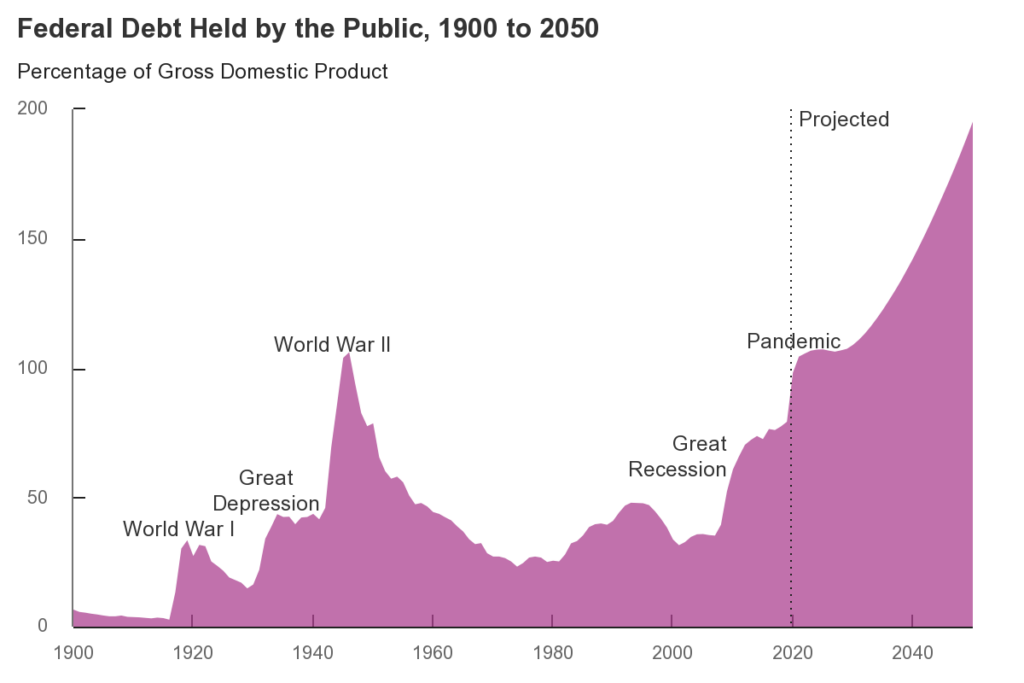
Public debt was to be avoided, except as demanded by war, for Washington considered it to be ‘a very important source of strength and security……One method of preserving it is to use it as sparingly as possible, avoiding occasions of expense by cultivating peace………avoiding likewise the accumulation of debt……. not ungenerously throwing upon posterity the burden which we ourselves ought to bear’. Perhaps these views on our $38 trillion of federal debt are why politicians no longer quote Washington’s Farewell Address in their campaign speeches.
Usurpation of Constitutional power was of great concern to Washington to keep it in its present happy state. On this topic he wrote: ‘Towards the preservation of your government and the permanency of your present happy state, it is requisite, not only that you steadily discountenance irregular oppositions to its acknowledged authority, but also that you resist with care the spirit of innovation upon its principles, however specious the pretexts. One method of assault may be to effect in the forms of the Constitution alterations which will impair the energy of the system and thus to undermine what cannot be directly overthrown’.
The energy of the American system has been slowly impaired by the additions of regulations and inefficiencies by each Congress and those operating the myriad agencies of the Welfare/Administrative State which now touch most areas of American existence. Permits for worthy public projects from highways to natural gas pipelines, which would lower energy costs in New England, may now take 5,10 15 years or never!
Avoiding foreign alliances is perhaps the most remembered and quoted admonition from Washington. After entering two World Wars to preserve our European friends at the loss of hundreds of thousands of American lives, current and future leaders might consider Washington’s admonition in the context our imbalanced NATO commitments: ‘Europe has a set of primary interests, which to us have none, or a very remote relation. Hence she must be engaged in frequent controversies, the causes of which are essentially foreign to our concerns’.
Our Founders have fallen out of favor among our modern political elites, but is that because they cannot justify their common malpractices and cannot be trusted to be principled in their pursuits?
TW3
February 19, 2026
John Whitmore Jenkins
www.jenkins-speaks.com
john@jenkins-speaks.com