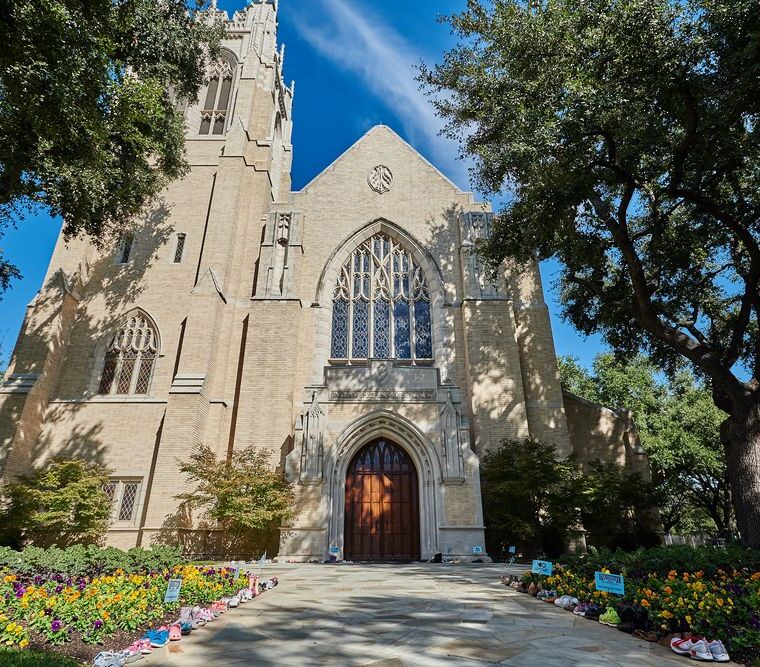
The local Dallas newspaper has been featuring the recent legal controversy between Highland Park United Methodist Church (HPUMC) and the Horizon Texas Conference – United Methodist Church (UMC) over governance issues. As a longtime member of the HPUMC, I see the controversy revolving around several key issues: Does a local UMC church belong to its congregation, which created it and expanded it over its years of serving its members and its community, or is the church owned and its operational religious practices governed by the denomination with which its members chose to affiliate for a common religious purpose?
In this local situation, the Highland Park Methodist Church was organized as the University Church in its current location near Southern Methodist University in 1916, 110 years ago. From that small beginning, the church now has one of the largest Methodist congregations in the U.S., with over 15,000 members. The church was originally affiliated with the Methodist Episcopal Church, South, an American Methodist denomination. In 1968, that denomination merged with another Methodist denomination to form The United Methodist Church (UMC).
My membership in HPUMC began sixty-three years ago, when I moved to Dallas for a job. I was getting married there to a young woman from Puerto Rico. She was educated in Catholic nuns’ schools, and as a Baptist, we needed a church for us to marry in a town where we were newcomers. Graciously, an assistant HPUMC minister agreed to marry us, and the church welcomed us into its congregation.
The specific action HPUMC officials contested with the Conference was keeping the church congregation from separating from the UMC over issues of social and political advocacy outlined in the UMC denomination’s revised 2020/2024 Book of Doctrine. That UMC action caused 7,660 UMC churches to disaffiliate from the denomination from 2020 to the end of 2023.
American Protestant churches have lost members as those identifying as Christians declined from 90% in 1963 to as low as 62% in 2023-24. The most severe collapse occurred in Mainline Protestantism, whose share of the U.S. population declined from 30 percent in 1978 to 11 percent in 2023-24. Christian denominations that were affiliated with the National Council of Churches (NCC) suffered the most significant declines – mainline hierarchical denominations like the United Methodist Church, Evangelical Lutheran Church in America, and Presbyterian Church (USA). Mainline protestant churches once claimed over 30% of the population in 1970, but by 2023-24, their share had plummeted to just 11%. UMC membership declined between 1968 and 2022 from 11 million to less than 5.5 million members.
The National Council of Churches was formed in 1950 as an ecumenical partnership of 38 faith groups, including Methodist denominations. The NCC’s stated objective was “to effect positive change for the betterment of society by promoting social welfare programs”, akin to those argued by American political parties. To further its chosen political causes, the NCC updated its social agenda in 2007 with its “Social Creed for the 21st Century,” which included restorative justice, immigration policies, military spending, and sustainable use of the earth’s resources.
The HPUMC Council members, along with present and past ministers, recommenced a vote of the members, which has just taken place. Local church members voted overwhelmingly to leave the United Methodist Conference (90.35% of 4,775 members voting). But, by trying to separate the Church from the State and keep the HPUMC from becoming a divided congregation along political lines, the church may have its fate legally decided in a Texas courtroom.
However, whatever the outcome of any Texas civil trial between this local Dallas church that was sued by its conference, the issue of separating the State from the Church will continue to plague Protestant congregations throughout the nation with politically divided churches and continued membership losses.
TW3
John Whitmore Jenkins
October 29, 2026