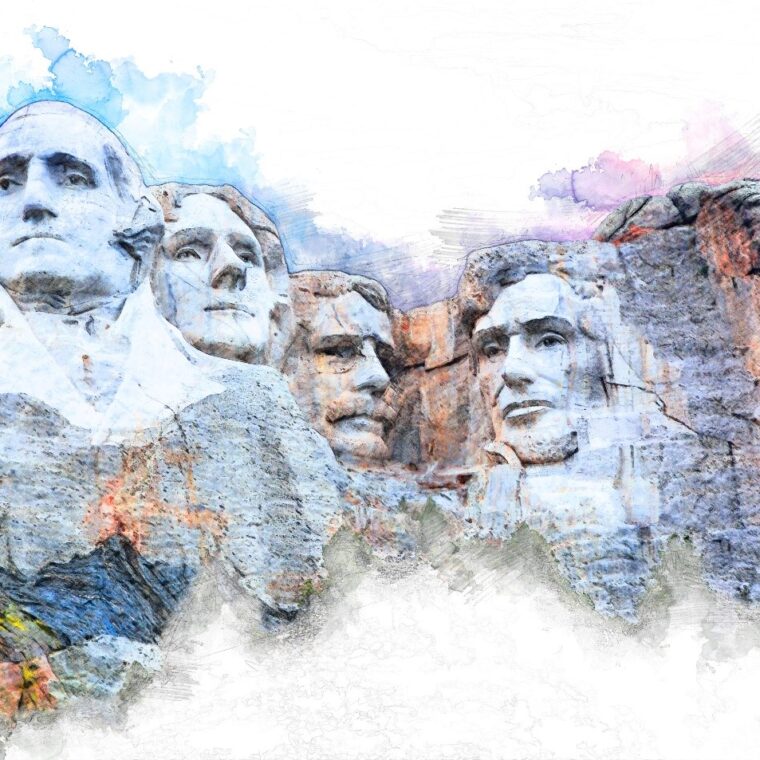
On Mount Rushmore, President Theodore Roosevelt (1901-1909) is tucked in between George Washington and Thomas Jefferson on his left and Abraham Lincoln on his right. Chosen as America’s greatest presidents during its first 150 years, these 60-foot sculptures located in the remote Black Hills of South Dakota were carved in granite between 1927 and 1941. They were chosen to represent the nation’s foundation, expansion, development, and preservation.
Republican President Theodore Roosevelt has been largely overshadowed by his cousin, a Democrat, Franklin Delano Roosevelt (1933-1945), whose four elections spanned the Great Depression and World War II. This other Roosevelt was reintroduced to many history-deprived viewers during America’s 250th Anniversary Celebration with the opening of the Theodore Roosevelt Presidential Library in Medora, North Dakota, followed by the Mount Rushmore celebrations.
Dominating the first decade of the 20th Century, Roosevelt was a celebrity of the Spanish-American War with his Congressional Medal of Honor award for extraordinary bravery leading his Rough Riders in winning the Battle of San Juan Heights. After the war erupted in 1898, he resigned his post in the McKinley Administration as Assistant Secretary of the Navy to form with Army Colonel Leonard Wood the first U.S. Voluntary Calvary Regiment. His 1882 book, “The Naval War of 1812”, established Roosevelt as an early naval scholar, and he became an early advocate that ‘that only nations with significant naval power had been able to influence history, dominate oceans, exert their diplomacy to the fullest, and defend their borders’.
Roosevelt became Governor of New York in 1899 and served as Vice President under President William McKinley, who was running for his second term in 1901. As Vice-President, Roosevelt added to his legend with a speech that included his famous quote, “Speak softly and carry a big stick, and you will go far.” Already internationally known when McKinley was assassinated on September 14, 1901, Roosevelt became the 26th U.S. president, serving until March 4, 1909.
His theories on naval power and international strength caused him in 1903 to establish the location and begin construction of the Panama Canal, completed in 1914, which would facilitate projection of American naval power in both the Atlantic and Pacific Oceans. The Panama Canal was in line with his strong support of the Monroe Doctrine.
His international reputation was furthered in 1905 When Roosevelt was invited and successfully negotiated the end of the Russo-Japanese War with the Treaty of Portsmouth, signed on September 5, 1905, and winning him the 1906 Nobel Peace Prize. Later in his second term, he created the Great White Fleet of sixteen battleships, with escorts, which traversed the globe. Warships painted white in this armada were used by Roosevelt to showcase American naval projection worldwide and symbolize America’s ascent as a great world power under his leadership.
Domestically, Roosevelt began reforming the Republican Party, breaking it away from a party of Big Business into a broader party attuned to the needs of all Americans. To lower prices for ordinary Americans, he broke up bad monopolies and attempted to achieve a balance between capital and labor interests, along with consumer protection. He initiated policies to conserve natural resources, including national parks, monuments, and forests.
He sought to achieve under the Constitution a more perfect Union.
Roosevelt chose not to run for reelection in 1908 and supported his Secretary of War, conservative Republican William Howard Taft, with whom he had a warm relationship. They grew apart during Taft’s presidency, and in 1912 Roosevelt challenged him for the presidency, dividing the Republican Party. With Roosevelt not winning another term, it was Ronald Reagan in 1980, and thirty-six years later, Donald Trump, before the Republican Party broadened its base again, including working Americans in its ranks.
More disastrous for America, though, the split Republican vote allowed radical Democrat Woodrow Wilson (1913-1921) to win the 1912 presidential election. A theoretical academic, Wilson studied and espoused German political theories of governance that were contrary to those of the American Declaration of Independence and the U.S. Constitution, which he believed “could be stripped off and thrown aside like a garment, and the nation would still stand forth clothed in the living vestment of flesh and sinew, warm with the heart-blood of one people, ready to recreate constitutions and laws”.
Wilson further believed that “the new order of society has not been made to fit and provide the convenience or prosperity of the average man”. He believed that governance was a science that should be administered by experts, separate from elected officials, schooled in academic theories, which he published in 1887, titled “The Study of Administration”. Upon his election, Wilson immediately began establishing governmental structures that would replace our Creator-endowed rights with rights allocated to the People by an evolving, self-regulating system rather than a static set of rules.
Wilson bequeathed this system to the Democratic Administrations of Franklin Delano Roosevelt (1933-1945), Barack Obama (2009-2017), and Joe Biden (2021-2025), who used it to create today’s Welfare/Regulatory State with $39 trillion in federal debt. The Republic, whose States were given broad responsibilities under the Constitution, was replaced by a centralized, inefficient bureaucracy.
Elections do matter, even those calamitous ones whose academic historians would rather not write about!
TW3
July 9, 2026
John Whitmore Jenkins
www.jenkins-speaks.com
john@jenkins-speaks.com